
Start with the problem you want to understand
“Work on this position” is a starting point. Make it more specific by asking your coach which part of the situation to focus on. What should each partner be trying to change or maintain?
The general purpose is to limit the scope of sparring so you can work on a particular position. Stephan Kesting gives a historical example of this approach. You do not need to turn the round into a test of everything you know.
Agree on the start, task and reset
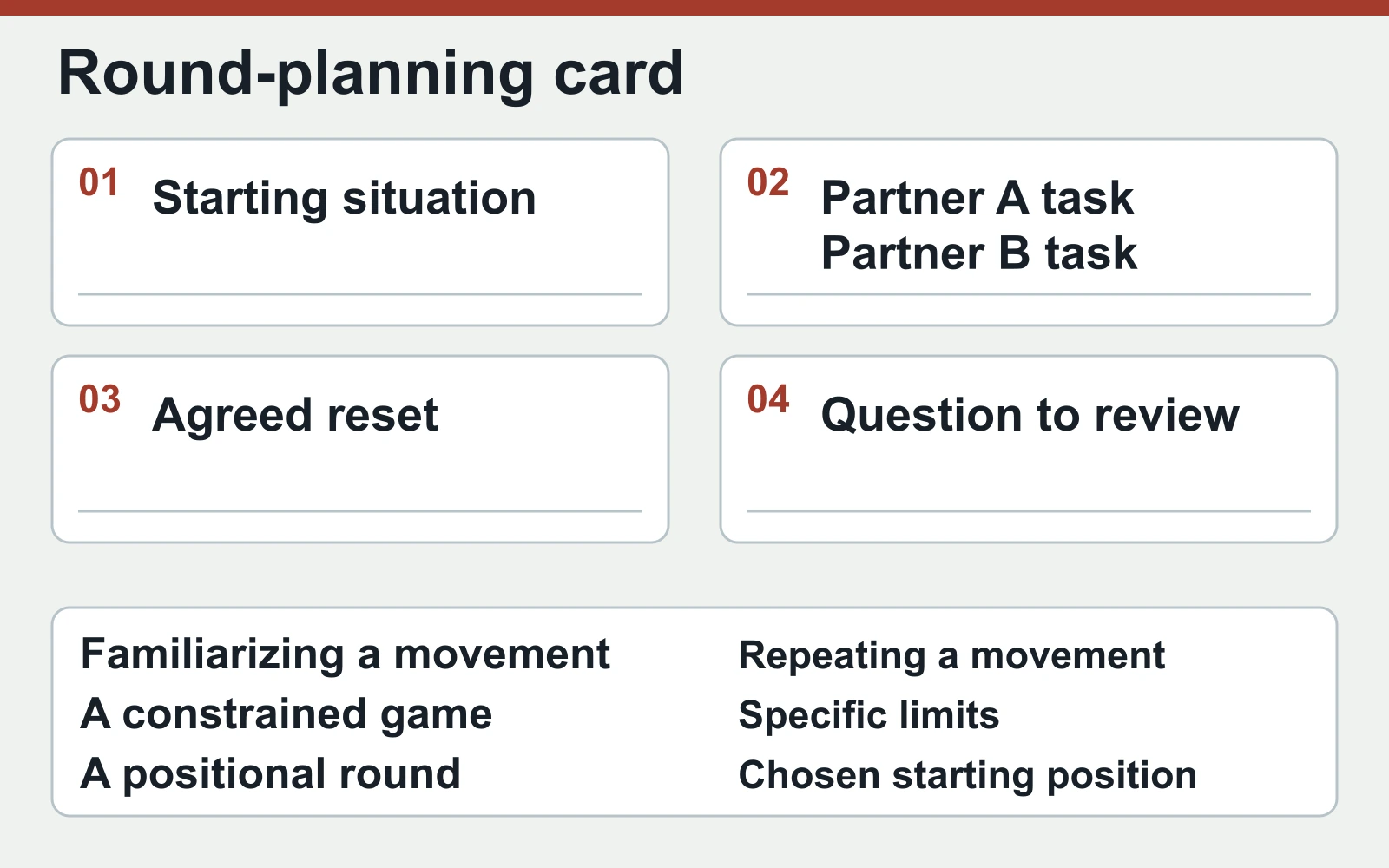
Before beginning, have both partners describe the setup. Agree on the starting situation, Partner A’s task, Partner B’s task and the change that means you reset. Your supervising coach sets appropriate conditions.
For example, you might agree that a particular change ends the round. Your review question could then be: “Did that change happen?”
A drill, a constrained game and a positional round are different tools
Repeating a movement can serve a different purpose from practicing it when timing and context matter. Lachlan Giles discusses that distinction. Familiarizing yourself with a movement and exploring when it becomes available are different questions.
A narrowly constrained game places specific limits on what the partners are trying to do. Rob Biernacki describes restricted games with narrow conditions. A broader positional round can leave more of the situation open while keeping a chosen starting position and purpose.
These are different tools, not a required sequence.
Use this round-planning card
Use this optional card to plan a round with your supervising coach.
Phantom’s schedule names positional sparring. For the broader program, visit the Adult Jiu Jitsu page.
Review what happened before changing the task
- Describe what happened, including whether the agreed change occurred and both partners recognized it as the reset
- Check for a task or reset mismatch; clarify it with your coach before interpreting the result
- Discuss whether to keep the same question or change the task.