What is the adult BJJ belt order?
The usual adult order is white, blue, purple, brown, then black. The full IBJJF system also has ranks beyond black.
- 1. White belt
- 2. Blue belt
- 3. Purple belt
- 4. Brown belt
- 5. Black belt
If you're choosing a place to train, see Phantom's adult classes. Your belt doesn't tell you which class will fit your first visit.
What is the IBJJF kids BJJ belt order?
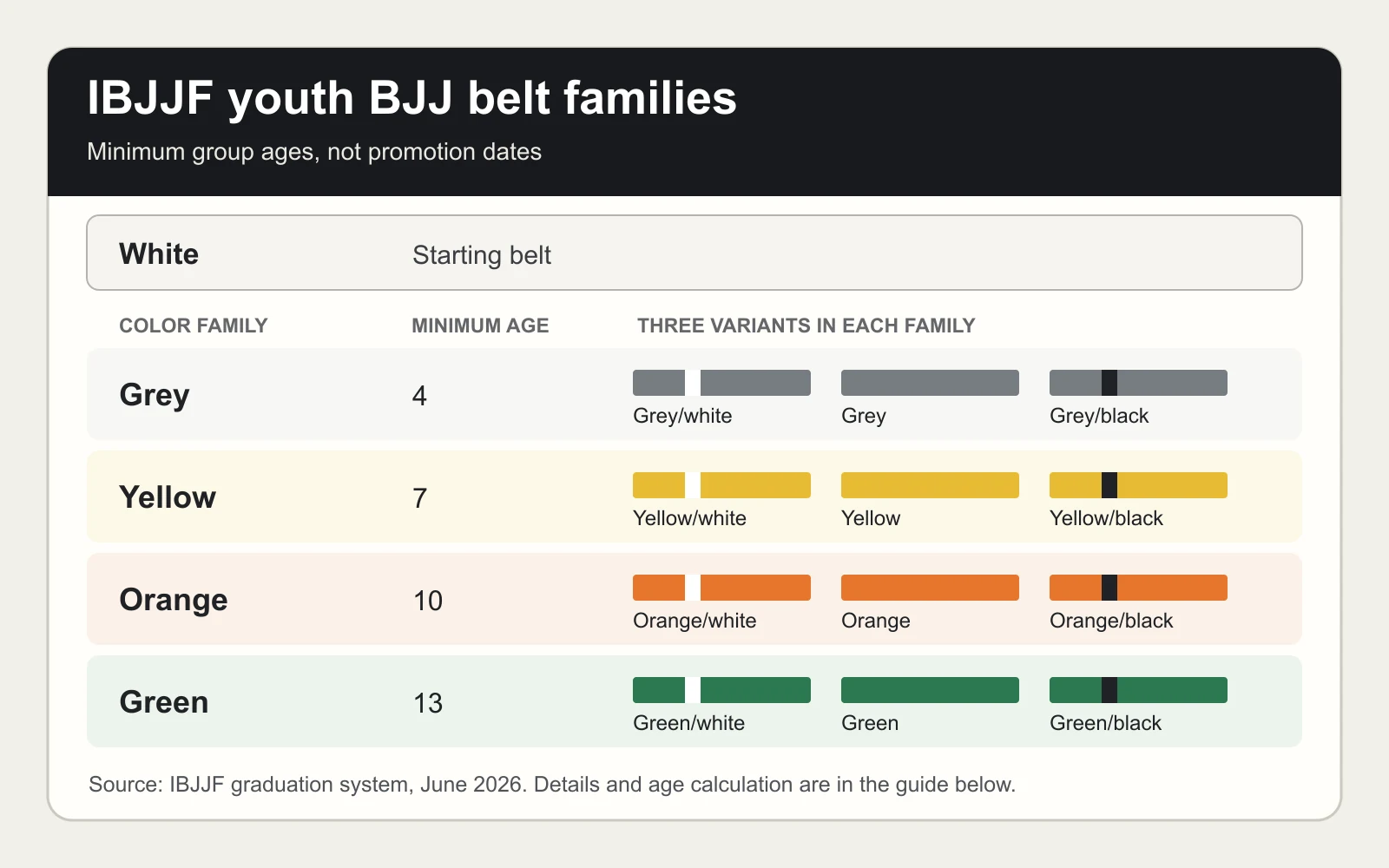
Kids start at white. The youth color families then go grey, yellow, orange, and green. Each family has white, solid, and black variants. The June 2026 IBJJF graduation system lists this order and its minimum group ages.
- White: the starting belt.
- Grey, minimum age 4: grey/white, grey, grey/black.
- Yellow, minimum age 7: yellow/white, yellow, yellow/black.
- Orange, minimum age 10: orange/white, orange, orange/black.
- Green, minimum age 13: green/white, green, green/black.
Those are IBJJF minimum ages, not a Phantom promotion timetable. A child does not earn the next belt just by having a birthday. For IBJJF competition, age is counted by calendar year: the current year minus the child's birth year. That can differ from their age on the day of an event.
What happens to a kids BJJ belt at 16?
In the calendar year a child turns 16, the IBJJF graduation system allows a student at white to stay at white. Someone at grey, yellow, or orange moves to blue. Someone at green may move to blue or purple, based on the professor's decision. These are federation transition rules, not a promise about a Phantom student's next rank.
How can you ask about your child's BJJ progress?
Ask the coach, “What is my child learning now, and how do you assess their progress?” That gives you something useful to discuss without treating an age or a stripe as a deadline. A child's instructor decides when they're ready for a promotion.
Phantom's Kids BJJ Classes in Herndon are currently described for ages 6–9 and 10–13. Those class groups are separate from the IBJJF belt ages above. See the program page for the current class details.